
A 50-year mortgage? Hard Pass
Nov 19, 2025

Last week, the idea of a 50-year mortgage moved from the fringe to the mainstream when President Trump floated the idea of extending the typical home loan from 30 to 50 years, arguing it would make monthly payments more affordable and help more Americans get into homes.
Trump Floats 50-Year Mortgages—But Would You Want One?

To understand this, it may be helpful to go back in time. Until the 1930s, many U.S. home loans were short-term (sometimes just three to five years) with large "balloon" payments that left many homeowners at risk. But once they introduced the 30-year fixed-rate mortgage, allowing homeowners to spread their payments out and avoid the large payment at the end of the loan, it made homeownership more accessible (also giving borrowers stability and lenders more predictable returns).
Bottom line, the 30-year mortgage fundamentally reshaped how Americans build wealth.

Let's look at how a 50-year mortgage compares to its 30-year sister on a $500,000 loan.
The monthly payment on a 30-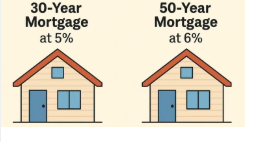 year at 5% would be $2,684.
The monthly payment on a 50-year at 6% (because it's not reasonable to expect the bank to not charge a higher interest rate) would be $2,997.
No cost savings there.
Over 30 years, $2,684/m (*30 years) would total $966,000. Let's pause for a moment to recognize that once you've subtracted out the $500,000 principal, that leaves you with $466,000 in interest you're paying over 30 years. Almost enough to buy another house. 30 years is already a reallllly long time to have a loan outstanding.
Now, for the 50-year, ($2,997*50 years) is a total of $1,798,000. Subtracting out the $500,000 leaves you with $1,300,000 in total interest paid.
Bottom line: they're suggesting that a longer term would lower our monthly costs now, which would only be the case if the bank charged the same interest rate (5%) for both mortgages, which they wouldn't.
In this example, a 50-year term would mean you'd be paying nearly three times the interest over the life of the loan.
In addition, a 50-year term would mean it would take much longer to start to build equity (remember how amortization works).
ALSO, if the average homebuyer is now 40, are we supposed to be paying our mortgages off until we're 90?
Hard. Pass.
Stay in the Loop
Continue on your learning journey with our weekly newsletter!
You’ll also be the first to hear about updates on our book launch,
free resources, and you'll get early access to our courses!
We hate SPAM. We will never sell your information, for any reason.