Our Heaviest Financial Burden
Mar 11, 2026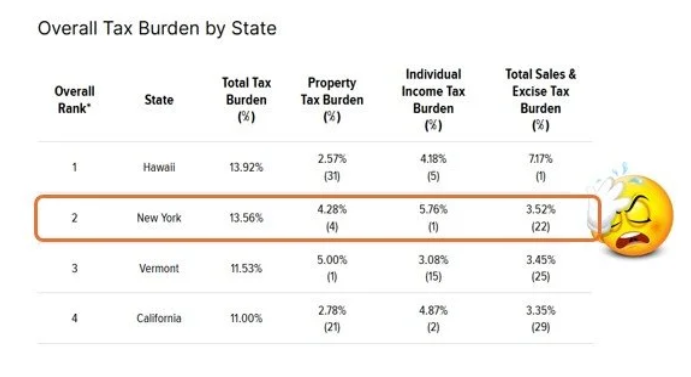
Why Where You Live Can Matter As Much As How Much You Earn

Taxes.
Blah.
But understanding how heavy a financial burden taxes are can actually give you power instead of fear.
This article from WalletHub really gave me pause.
It says the tax burden in NY is one of the highest in the country!
(For transparency, I write articles for WalletHub occasionally – also they're an incredible resource.)

Across the United States, tax burdens vary dramatically. WalletHub defines tax burden as the share of personal income residents pay to state and local governments, including income, property, and sales/excise taxes.
In other words, how much of their income goes to paying taxes.
While we all pay on the same federal schedule, state income taxes vary, property tax rates vary and sales tax rates vary.
They report the states with the highest overall tax burdens include:
- Hawaii – highest overall
- New York – second-highest overall
- Vermont, California, and Maine also rank near the top.
On the flip side, states like
- Alaska
- Wyoming
- New Hampshire
- South Dakota
have some of the lowest overall tax burdens in the country.
Why does this matter? Because the more of your income that goes to taxes, the less you have available for savings, investing, and long-term planning, especially when combined with high living costs.
And, if you understand this, you can try to make decisions that benefit you (more on that below).

What's the bold takeaway?
High tax burdens often spark alarm bells, but context matters. Some high-tax states provide extensive public services: infrastructure, schools, transportation, healthcare supports, and safety nets that we use daily.
Meaning, you could live in a lower tax state, but have to pay for more stuff out of your pocket.
- You could have to buy a(nother) car due to poor public transportation.
- You may have to pay for snow removal, or road maintenance.
- Healthcare programs or social safety nets may be more limited in lower tax states.
- You could have access to fewer parks, libraries or public recreation programs.
- There could be more crime if the police force is underfunded, or an overall slower response time to emergencies.
None of this means higher taxes are better or worse. It just means that when you evaluate tax burdens, it's important to consider what those taxes are funding.
Yes, TAXES ARE OUR HEAVIEST FINANCIAL BURDEN (I like to shout that), but what control do we have?
Here are some decisions we do have control over.
1. Where you live.
This is the big one. State income tax, property taxes, and sales tax all vary widely. Two people earning the same salary in different states can end up with very different take-home income.
2. Where you buy property.
Property taxes vary dramatically even within the same state. Understanding local tax rates can save homeowners thousands per year over the life of a mortgage.
3. Where you work or retire.
Some states tax retirement income heavily. Others don't tax it at all. That can make a meaningful difference when planning long-term financial security.
4. How you invest.
Tax-advantaged accounts like 401(k)s, Roth IRAs, HSAs, and 529 plans can dramatically reduce the portion of your income lost to taxes.
5. Whether you prioritize tax efficiency.
Holding investments longer, using index funds, and being thoughtful about capital gains can help minimize taxes over time.
6. When you realize income.
Bonuses, stock sales, and withdrawals can sometimes be timed strategically to reduce tax impact.
7. How you structure your work.
If you run a business or side hustle, entity structure and deductions can influence how much tax you ultimately pay.
None of these decisions are purely about taxes. Life, family, career, and community matter far more.
But understanding the tax burden helps you see the full financial picture, because building wealth isn't just about what you earn, it's about what decisions you make about what you get to keep.
Stay in the Loop
Continue on your learning journey with our weekly newsletter!
You’ll also be the first to hear about updates on our book launch,
free resources, and you'll get early access to our courses!
We hate SPAM. We will never sell your information, for any reason.