
Boring Millionaires Hiding In Plain Sight
Feb 11, 2026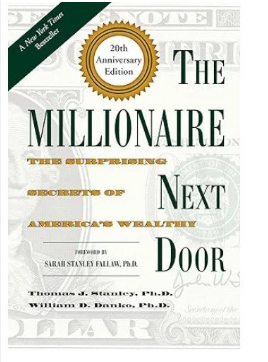
Let's dissect the classic principles of The Millionaire Next Door: The Surprising Secrets of America's Wealthy.

Can we shift how we define success?
Most people conflate wealth with income, but Thomas Stanley and William Danko flipped this on its head with their contemporary classic book, The Millionaire Next Door.
There is much to say about this book, I want to focus on their concept of PAWs and UAWs (Prodigious Accumulators of Wealth and Under Accumulators of Wealth).
A PAW is simply someone who is exceptionally efficient at turning their income into net worth.
Regardless of what they earn.
Conversely, a UAW might earn $250k a year (or more) but spend it all.
The simple formula is:
Expected Net Worth (ENW) = (Age * Pre-Tax Salary) / 10
If your actual net worth is twice your expected net worth, you're a PAW. If it's half or less, you're a UAW.
Ex. 30 year old making $100,000 = (30*$100,000) / 10 = $300,000
If this person has an actual net worth of > $600,000, they are a PAW.
If this person has an actual net worth of < $150,000, they are a UAW.
If this person has an actual net worth between $300,000 and $600,000, they are an average accumulator of wealth.

The Millionaire Next Door was first published in 1996, to document a massive decade-long study of America's affluent. Stanley and Danko started out looking for people in "high-end" neighborhoods, only to realize that many people in big houses were actually broke.
They discovered that the real millionaires lived in middle-class neighborhoods, drove used cars, had non-traditional white-collar jobs, and perhaps most importantly, ignored what they called "The Joneses" (now we call it Vons).
The book became a cult classic with FIRE (Financial Independence Retire Early) fans, and personal finance enthusiasts because it proved that wealth is more about invisibly the result of frugality, than salary.
- Hard work
- Diligent saving
- Living below one's means
- Investing
They also uncovered:
- Most millionaires are first-gen wealthy
- They live in middle-class neighborhoods
- They drive modest cars
- They spend less than they earn
- They invest consistently
I think it's a powerful takeaway worth repeating.
Your earnings don't create wealth, what you DO with them does.
This insight is nearly 30 years old but still painfully relevant today.

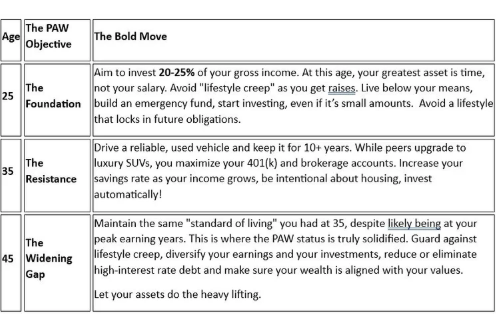
What being a PAW requires is a radical commitment to delayed gratification. Here's what that might look like as you age.
I'll say one last thing:
Being a PAW isn't about deprivation. It's about optionality.
More choices.
More flexibility.
More peace of mind.
My favorite part? You can start building that kind of wealth without anyone knowing.
Questions, thoughts, topics you're curious about? Email us at casey@your-orchard.com
Stay in the Loop
Continue on your learning journey with our weekly newsletter!
You’ll also be the first to hear about updates on our book launch,
free resources, and you'll get early access to our courses!
We hate SPAM. We will never sell your information, for any reason.