
Reports Show ONLY 57% of Adults in the US are Financially Literate, Ranking Us 14th in the World
Mar 19, 2025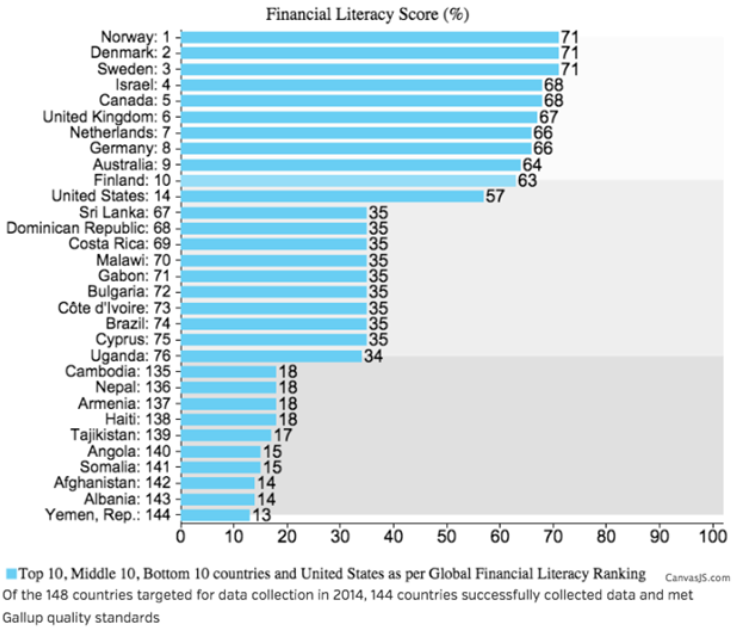

 How do you fare?
- Do you understand diversification?
- How about inflation?
- Can you explain how compounding interest works?
Take the quiz below and see how you do.

These are the five questions asked on the first-ever S&P Global FinLit Survey (sometimes called the Lusardi-Mitchell questions).
1. Suppose you have some money. Is it safer to put your money into one business or investment, or to put your money into multiple businesses or investments?
a. one business or investment
b. multiple businesses or investments
c. don't know
2. Suppose over the next 10 years the prices of the things you buy double. If your income also doubles, will you be able to buy less than you can today, the same as you can buy today, or more than you can buy today?
a. less
b. the same
c. more
d. don't know
3. Suppose you need to borrow 100 US dollars. Which is the lower amount to pay back: 105 US dollars or 100 US dollars plus three percent?
a. 105 US dollars
b. 100 US dollars plus three percent
c. don't know
4. Suppose you put money in the bank for two years and the bank agrees to add 15 percent per year to your account. Will the bank add more money to your account the second year than it did the first year, or will it add the same amount of money both years?
a. more
b. the same
c. don't know
5. Suppose you had 100 US dollars in a savings account and the bank adds 10 percent per year to the account. How much money would you have in the account after five years if you did not remove any money from the account?
a. more than 150 dollars
b. exactly 150 dollars
c. less than 150 dollars
d. don't know
(Answers below!)

Some of the bold findings in this report that struck me were:
1) A higher per capita income doesn't necessarily translate into a higher level of financial literacy.
2) Women are less likely to be financial literate than men and when asked the same questions, women are more likely to choose the answer "I do not know" than men.
3) In the major advanced economies, the youngest and the oldest people were the most vulnerable groups.
Answers:
1) B – This follows the principle of diversification, which reduces risk by spreading investments across various assets.
2) B – If both prices and income double, purchasing power remains unchanged.
3) B – Three percent of 100 is 3, so the total is $103, which is less than $105.
4) A – This is due to compound interest—15% of a growing balance results in a larger addition in the second year than in the first.
5) A – With compound interest, the balance grows each year, leading to more than $150 after five years.
Stay in the Loop
Continue on your learning journey with our weekly newsletter!
You’ll also be the first to hear about updates on our book launch,
free resources, and you'll get early access to our courses!
We hate SPAM. We will never sell your information, for any reason.